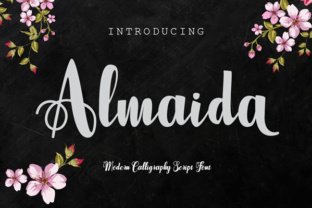
Almaida: A Handwritten Font That Warms Every Product You Make
I was sitting at my worktable last weekend, tweaking a candle label design for the third time. The wax had already been poured, the jars were waiting, and the only thing holding me back was the typeface. I needed something that felt personal, not stiff. Something that would make the word “Honey & Sage” look like it belonged on a handwritten note, not a factory shelf. That is when I opened Almaida for the first time. The moment I typed the phrase, the letters seemed to dance. That undulating baseline gave each character a gentle rise and fall, as if the font itself was breathing. I printed a test label, trimmed it by hand, and wrapped it around the jar. It looked like I had written every letter myself. That is the kind of magic Almaida brings to handmade products.
What Makes Almaida Special
Almaida is a handwritten script font with a personality that stands apart from standard digital scripts. Its most noticeable feature is the dancing baseline—those subtle ups and downs that make a word feel alive and unpolished in the best way. Instead of sitting flat on an invisible line, each letter sways slightly, creating a natural rhythm. This gives text a warm, personal feeling that is hard to replicate with rigid fonts. The font also includes Contextual Alternates and Standard Ligatures, which means that when you type certain letter combinations, Almaida automatically swaps in more natural connecting forms. The result is a flow that looks like genuine handwriting, not a computer-generated string of identical characters. For someone like me who makes products by hand and values authenticity, this attention to detail changes how my finished goods feel to customers.
Seeing Almaida on Labels, Tags, and Packaging
The first place I used Almaida in my shop was on product labels. I run a small line of soy candles and bath salts, and I had been cycling through the same few script fonts for years. Almaida gave me something different. On a candle label, the dancing baseline draws your eye along the scent name. “Vanilla Bean” looks like it was brushed on with a fine pen. “Cedar + Moss” takes on a cozy, cabin-like warmth. I also tried it on kraft paper hang tags for a batch of gift sets. I printed a few names directly onto cardstock, punched a hole, and tied them with twine. The letters looked soft and approachable, exactly the feeling I want customers to have when they unwrap a purchase. For packaging, Almaida works beautifully on short phrases and product names. I would not recommend it for long ingredient lists or dense paragraphs—its charm shines brightest when the text is kept concise, like a scent name, a shop name, or a short message.
Paper Goods and Printables That Feel Personal
Almaida is a natural fit for paper products and digital downloads. I designed a set of greeting cards for the holiday season using the font for the main sentiment. “Merry & Bright” in Almaida had a hand-painted quality that made each card feel like a one-off creation, even though I printed a small batch. For wedding invitation suites, the font works beautifully on the couple’s names and the reception header. Because it includes contextual alternates, no two invitations need to look identical unless you want them to. I also tested Almaida on printable wall art. A simple quote like “Grow at your own pace” in Almaida, paired with a clean layout, produced a print that looked like it came from a small-batch studio. For planner pages, the font is excellent for headers and decorative titles. It adds warmth to an otherwise structured layout. If you sell digital templates or printable stationery, Almaida gives your preview images a handmade appeal that stands out in a crowded marketplace.
Fabric, Mugs, and Home Decor
For makers who work with heat-transfer vinyl, sublimation, or screen printing, Almaida performs well on fabric and hard surfaces. I tested the font on a tote bag design using iron-on vinyl. The word “Farmhouse” in Almaida curved nicely across the cotton, and the dancing baseline added a casual, rustic feel. On a ceramic mug, I used Almaida for a short name in a monogram-style layout. The letters were clear and readable, even at a medium size. For wooden signs and farmhouse decor, Almaida gives a hand-lettered look that fits with modern rustic aesthetics. I would suggest testing the font at your intended cut size before committing to a large batch. The thin strokes in some alternate characters may require a slightly larger minimum size for vinyl cutting, especially with intricate ligatures. On a 4-inch wide sign, the font reads beautifully. On a tiny charm or a small sticker, you may want to select simpler letter combinations or increase the point size slightly.
Readability and Practical Tips for Product Makers
When you are producing physical goods, readability is not optional. Almaida maintains good legibility for a handwritten script, especially at medium to large sizes. For small product labels—think 1-inch round stickers or narrow jar labels—I recommend keeping the word count low and choosing letters without overly elaborate swashes. The font’s contextual alternates help by automatically selecting simpler connecting forms when needed. I also suggest testing your design in black ink on white paper first, then switching to colored or textured substrates. On dark backgrounds, the thinner parts of the letterforms may need a bolder weight or a slightly larger size to remain crisp. For cutting machines like Cricut or Silhouette, Almaida’s curves are clean, but you should check the cut preview to ensure that ligatures do not overlap in unexpected ways. A quick test cut on scrap material saves time and vinyl.
Pairing Almaida with Other Fonts
A well-paired secondary font gives Almaida room to shine without overloading the design. I have used it with a clean sans serif like Montserrat for product details and pricing on labels. The contrast between the warm script and a neutral sans serif creates a balanced, professional look. For more traditional projects, I pair Almaida with a simple serif like Lora or Playfair Display. The serif adds structure, and Almaida provides the emotional hook. If you prefer a more playful combination, a second handwritten font with a different weight or angle can work, but I keep the pairing minimal to avoid visual noise. On gift tags, I often use Almaida for the recipient name and a lightweight sans serif for “with love” or the date. The pairing makes the tag feel custom without being complicated.
What to Check Before You Start Selling
Before you use Almaida on products for sale, it is important to check what is included in the font package. Almaida comes with Contextual Alternates, Standard Ligatures, and a set of stylistic alternates that give you control over how each letter connects. Some versions include swashes or special characters—review the glyph panel to see what is available. Confirm the file formats (usually OTF and TTF) and ensure they are compatible with your design software and cutting machine. If you sell physical products like mugs, shirts, signs, or packaging, you need a commercial license that covers merchandise production. The same applies if you sell digital templates, printables, or SVG-style cut files that include the font outlines. Check whether the license extends to your specific use case—whether you are selling a limited batch of handmade goods or a large volume of digital downloads. Also verify multilingual support if your designs include accented characters or non-English names. Being clear on licensing from the start protects your shop and your creative work.
Almaida has become one of those fonts I reach for when a product needs to feel less like merchandise and more like something I made with my own hands. It brings warmth to labels, personality to packaging, and a gentle humanness to every project. Whether you are printing a single candle label or preparing a full product line, Almaida gives your text a voice that customers notice. And in a world full of mass-produced goods, that touch of warmth is exactly what handmade is all about.